
Two powerful, non-invasive tools that look beyond symptoms to understand what’s actually happening in the brain — and retrain it toward healthier patterns. Drug-free, evidence-based, and available as a complement or alternative to traditional treatment.
A Different Kind of Care
Standard psychiatric care relies primarily on symptom checklists, patient self-reporting, and clinical interviews to diagnose and treat mental health conditions. That approach is valuable — but it has limits. When symptoms overlap across conditions, or when medication isn’t producing the expected results, the subjective nature of traditional assessment leaves significant room for uncertainty.
Neurofeedback and BrainView Brain Mapping give our providers an objective, data-driven window into how your brain is actually functioning — not just how you’re describing it. That precision changes what’s possible in treatment.
Objective Brain Data
Unlike questionnaires and interviews, brain-based tools produce measurable, visual data about electrical activity, cognitive function, and brainwave patterns across regions.
Precision Over Guesswork
Identifying specific areas of over- or under-activation reduces diagnostic uncertainty and allows treatment to target the actual source — not just the symptoms.
Beyond Medication
For patients who want to reduce reliance on medication, can’t tolerate side effects, or haven’t responded to conventional treatment, these tools open new pathways.
Service 01
Non-invasive brain training that teaches your brain to self-regulate — naturally, without drugs, and with results that last.
What It Is
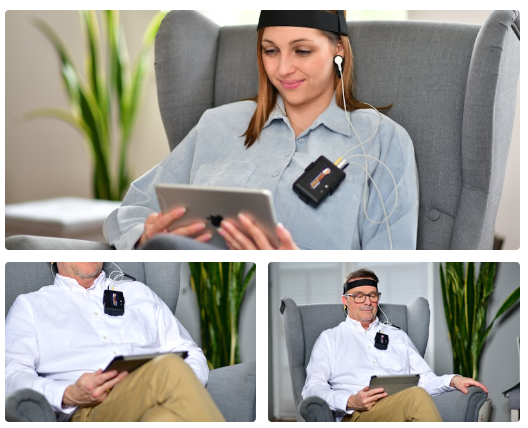
Neurofeedback — also called EEG biofeedback — is a form of biofeedback that uses real-time monitoring of brain activity to teach self-regulation. Small sensors placed on the scalp record your brainwaves as you watch a screen or listen to audio. When your brain moves toward a healthier pattern, the signal continues clearly. When it drifts, the signal fades — providing instant feedback that trains your brain to correct itself.
Over repeated sessions, the brain learns to sustain those healthier patterns on its own. It’s not conditioning in an artificial sense — the brain is naturally neuroplastic, and neurofeedback leverages that capacity to create lasting change. Unlike medication, the results don’t stop when treatment ends. The brain retains what it’s learned.
The Process
Sessions are comfortable and straightforward — most patients describe them as relaxing. Here’s what to expect.

Small, non-invasive sensors are placed on the scalp. No electricity enters the brain — sensors only read its activity. The process is completely painless.


Your brainwave activity is displayed and analyzed in real time as you relax, watch a video, or listen to audio — no effort or concentration required.

When your brain produces healthy wave patterns, the audio/video continues clearly. When it drifts, the signal fades — your brain automatically self-corrects toward the reward.

With repetition — typically 20 to 40 sessions — the brain builds new neural pathways and sustains healthier patterns independently. Results are durable because the brain has genuinely relearned.
The Evidence
Neurofeedback has decades of clinical research behind it — with its strongest evidence in ADHD, anxiety, PTSD, and sleep. The American Academy of Pediatrics designated neurofeedback a Level 1 “best support” evidence-based treatment for childhood ADHD — the same category as medication.
American Academy of Pediatrics evidence rating for ADHD — the highest category, matching medication

Of patients show significant improvement after an average course of neurofeedback sessions across anxiety, ADHD & depression
Typical session length — comfortable, non-invasive, with no recovery time needed
Unlike medication, neurofeedback produces no systemic side effects — making it suitable for patients of all ages
Service 02
A 30-minute, objective assessment of brain activity that provides a detailed map of how your brain is functioning — and where it isn’t.
What It Is
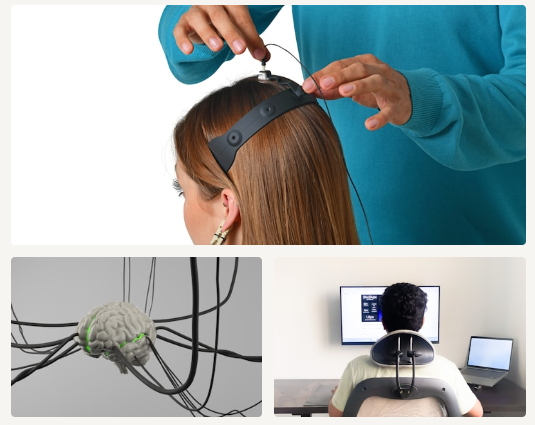
BrainView is a comprehensive, non-invasive neurological assessment that uses a combination of EEG, functional near-infrared spectroscopy (fNIRS), and quantitative EEG (qEEG) to create a detailed, visual map of brain activity across regions. The system compares your brain’s electrical patterns against a standardized clinical database — instantly highlighting areas of over- or under-activation associated with specific mental health conditions.
Traditional psychiatric diagnosis relies on what you report about how you feel. BrainView adds something that self-reporting can’t provide: objective, measurable data about what’s actually happening neurologically. For patients who’ve been cycling through treatments without clarity, this kind of precision changes everything. It takes the guesswork out of diagnosis — and directs treatment where it’s actually needed.
The Process
A complete brain map in 30 minutes — comfortable, non-invasive, and immediately actionable. Here’s what the process looks like.
Sensors are placed on the scalp in a standardized configuration. Nothing enters the brain — sensors only measure and record electrical activity. The setup takes minutes and is completely painless.
You relax while BrainView records brainwave activity, cognitive performance measures, reaction times, and neurological markers across multiple brain regions simultaneously.
Your data is analyzed and compared against a standardized normative database. The result is a visual “head map” — color-coded regions showing exactly where brain activity is imbalanced.
Your provider reviews the findings with you and uses the map to build or refine a targeted treatment plan — whether that’s guiding neurofeedback protocols, adjusting medication, or informing therapy.
What It Shows
BrainView identifies neurophysiological markers linked to specific conditions — providing a level of diagnostic precision that symptom-based assessment alone cannot match.
Complete brain assessment — comprehensive neurological data in a single, comfortable session
EEG + fNIRS + qEEG combined in one assessment — more comprehensive than single-modality tools
Data-driven diagnosis reduces the risk of misdiagnosis when symptoms overlap across conditions
Repeat maps over time show treatment progress objectively — not just how you feel, but how your brain is actually changing
The Complete Picture
BrainView Brain Mapping and Neurofeedback are most powerful when used in combination — one provides the map, the other follows it. Together they create a precision-guided approach to brain health that standard psychiatric care can’t replicate.
BrainView Maps the Brain
A 30-minute assessment identifies exactly which regions are dysregulated, which patterns are driving symptoms, and where targeted intervention will be most effective.
Protocols Are Personalized
Rather than using generic neurofeedback protocols, your provider designs a targeted training program based on your specific brain map — maximizing effectiveness from session one.
Neurofeedback Retrains the Brain
Guided by the map, neurofeedback trains the specific regions and brainwave patterns identified as dysregulated — producing precise, lasting improvements in function and symptoms.
Who Benefits
Neurofeedback and BrainView Brain Mapping have demonstrated strong outcomes across a wide range of neurological and psychiatric conditions — particularly where medication alone has been insufficient.
Attention & Focus
ADHD (children & adults)
Attention difficulties
Executive function
Processing speed
Mood & Anxiety
Depression
Generalized anxiety
Panic disorder
Mood dysregulation
Trauma & Stress
PTSD
Complex trauma
Chronic stress
Hypervigilance
Sleep & Cognitive
Insomnia
Sleep disorders
Memory difficulties
Brain fog
Neurological
TBI & concussion recovery
Autism spectrum
OCD
Migraines
Treatment Resistance
Medication non-response
Overlapping diagnoses
Diagnostic uncertainty
Symptom plateau
Your Care Experience
These tools integrate seamlessly into your existing care at Psych Matters — or can stand alone depending on your situation. Here’s how the experience typically unfolds.
Clinical Consultation First
Before beginning any brain-based services, you’ll have a clinical consultation to review your history, goals, and whether neurofeedback, brain mapping, or both are the right fit for your situation.
Brain Map as the Starting Point
For most patients, a BrainView Brain Map is the natural first step — it provides the objective data that allows neurofeedback protocols to be precisely targeted rather than generic.
Personalized Protocol Design
Your provider reviews your brain map results and designs a neurofeedback training program targeted to your specific brain activity patterns, symptoms, and goals.
Consistent Sessions Over Time
Neurofeedback works through repetition — typically 20 to 40 sessions of 30 minutes each. Progress is tracked and protocols adjusted as your brain responds and patterns shift.
Progress Tracked Objectively
Repeat brain maps at key intervals provide objective data on how your brain is changing — not just how you feel, but measurable shifts in brainwave patterns and cognitive function.
Coordinated with Your Full Care Plan
These services work alongside therapy and psychiatric care — not instead of them. Your Psych Matters providers coordinate across all tracks of your treatment so everything reinforces everything else.
Why Psych Matters
Not all practices offering these services have the clinical integration and expertise to deliver them effectively. Here’s what sets our approach apart.
Integrated with Full Psychiatric Care
Our neurofeedback and brain mapping services exist within a full psychiatric group practice — coordinated with medication management, therapy, and diagnostic evaluation. Not a standalone wellness offering.
Map-Guided Protocols
We don’t use generic neurofeedback protocols. Brain mapping results directly inform and personalize training — meaning every session is targeted to your brain’s actual patterns, not a standardized template.
All Ages Welcome
Neurofeedback is especially effective for children and adolescents with ADHD, anxiety, and learning challenges. Our providers have experience working with patients from young children through older adults.
Available In-Person
Brain mapping and neurofeedback are in-person services, available at our Midtown Manhattan and Dallas locations. Some elements of care planning and follow-up can be supported via telehealth.
Evidence-Based, Honestly Communicated
We present these services with the clinical honesty they deserve — strong evidence for specific conditions, genuine potential for treatment-resistant cases, and clear expectations about what these tools can and can’t do.
HSA/FSA Eligible
Neurofeedback and brain mapping are typically eligible for Health Savings Account (HSA) and Flexible Spending Account (FSA) reimbursement. We’ll help you understand your options before your first session.
Common Questions
Yes — neurofeedback is non-invasive and has an excellent safety profile. Nothing enters the brain; sensors only read its electrical activity. The most common side effects reported are mild fatigue or temporary changes in alertness immediately following a session, which resolve quickly. There are no systemic side effects comparable to those associated with psychiatric medication. Neurofeedback has been used clinically for over 50 years with no serious adverse events in properly conducted protocols.
The typical course of neurofeedback is 20 to 40 sessions, each lasting approximately 30 minutes. Some patients notice meaningful changes within the first 10 sessions; others require the full course or more. The number depends on the condition being addressed, its severity, how long it has been present, and individual neuroplasticity. Your provider will give you a realistic estimate based on your brain map results and clinical picture, and progress is reviewed regularly throughout treatment.
No — neurofeedback is frequently used alongside medication, and many patients see improved outcomes from the combination. Some patients choose to gradually reduce medication under their prescriber’s supervision as neurofeedback produces results, but this is never a requirement or expectation. Any medication changes are handled by your psychiatric provider and based on your clinical response. The two approaches work together, not in opposition.
A BrainView Brain Map provides a detailed, region-by-region picture of your brain’s electrical activity — showing which areas are over- or under-active compared to clinical norms. It identifies specific brainwave frequency imbalances associated with conditions like ADHD (elevated delta), depression (elevated alpha), anxiety (elevated beta), and memory difficulties (decreased theta). It also measures cognitive performance markers including reaction time and processing speed. The result is a visual map that gives your provider objective data to refine diagnosis, select targeted neurofeedback protocols, and track treatment progress over time.
Yes — and children are often among the best responders. The American Academy of Pediatrics has designated neurofeedback a Level 1 “best support” evidence-based treatment for childhood ADHD, equal in evidential weight to medication. For children who experience significant side effects from stimulant medication, who haven’t responded adequately to medication, or whose parents prefer a non-pharmacological approach, neurofeedback is a clinically well-supported option. Our providers have experience working with children from elementary school age through adolescence, and the sessions themselves are engaging and comfortable for young patients.
Currently, most insurance plans do not cover neurofeedback or qEEG brain mapping as standard benefits, though this is an evolving area. However, both services are typically eligible for reimbursement through Health Savings Accounts (HSA) and Flexible Spending Accounts (FSA) — which significantly offsets the cost. We’re transparent about pricing before you begin and can help you explore which payment options apply to your situation. Many patients find the long-term cost favorable when compared to ongoing medication expenses and repeated treatment attempts.
READY TO GET STARTED?
A 30-minute brain map is the clearest starting point — and it changes the conversation about what treatment can look like for you.